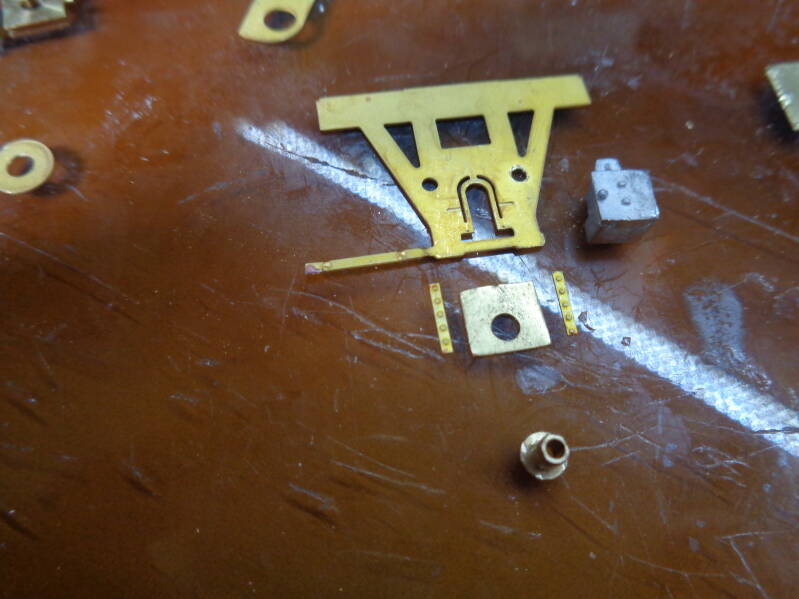
It turns out I don't need the bearing carriers form the Slaters kit after all. Some 'squares' of brass, with rivet strip attached, and a bearing pushed through from the back provides a suitably sliding arrangement to allow movement for the springs to flex. I had to flatten two sides of the bearing to get it into the slot in the axle guard, which provided an added bonus of preventing the axle box trying to rotate - always a problem when doing working springs. So far it's all going well. Too well...
Strangely, roller bearings provided exactly the right spacers....
It's been an interesting few days down at Soddingham. Wondering in to Loftshire one morning and switching the big white switch and.... no horn from the Western. I leave one short horn sound on so it honks when the layout powers up. Then, after some moving of stock about, honk goes the horn and all is well. This continues at every power on, but whatever is fixing the short is seemingly random, in time and space. Eventually all the rolling stock is off and wiring checked. NFF. Put each bit of rolling stock back on and test - random results. Eventually I'm reduced to moving point blades so neither side touches and finally - No.1 Points is the culprit. Power up with the points in the normal position, or reversed; short circuit. Power up with neither blade contacting the stock rails; absolutely fine. Release the blades and switch the points merrily and all is good - until the next power up. I'm eyeing the DCC Concepts solenoid controller suspiciously...
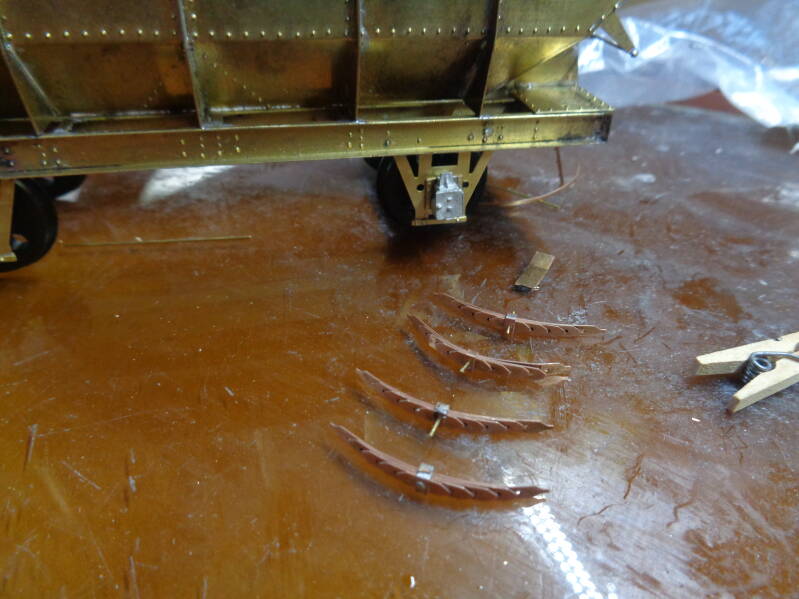
In between bouts of hair pulling frustration, progress has been made on the 21t hopper. I made up a set of 5 leaf springs (the correct 7 leafs are currently out of stock.
It now became apparent that 5 leaves wasn't going to work, they didn't look right and they weren't deep enough. So I made up a set of eight leaf ones, one more than prototype, but hey ho. These worked much better but testing revealed that the w-iron was pushing the spring 'over', as in not vertical, due to somewhat narrow sole bars. So off came the w-irons and two thicknesses of brass used to space the w-irons in board. Much better. Then a buffer height check. The height of the buffers depends on the curvature of the springs. I've found that following the Hobby Holidays instructions gives the right result, adjustment by rolling does work if need be though.The last photo is with everything done except bending the top leafs round the 'bolts' in the dumb irons to center the spring at rest, but allows movement when compressed. It has a very high faff factor, but making working leaf springs is amazingly satisfying - the running qualities are beautiful, so smooth. Sadly getting the bits to do all my wagons this way isn't possible, but I have a few left to do 'selected' ones.
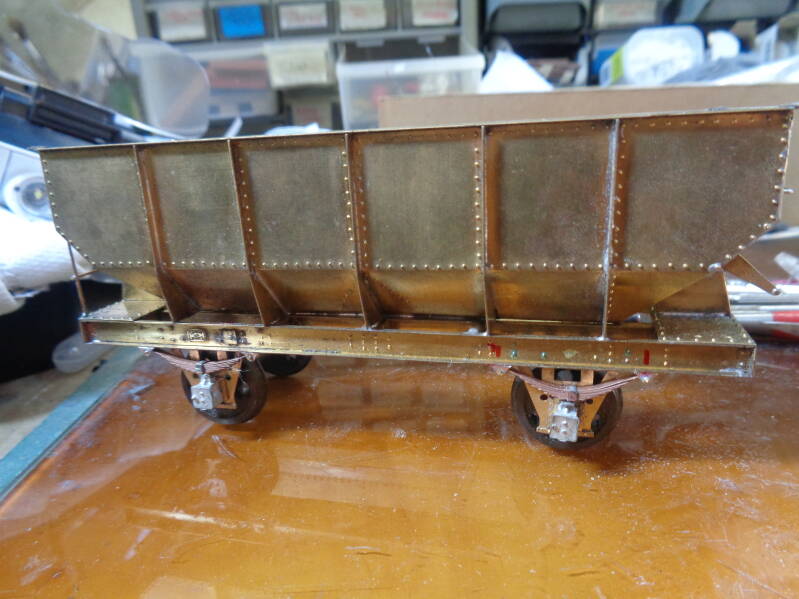
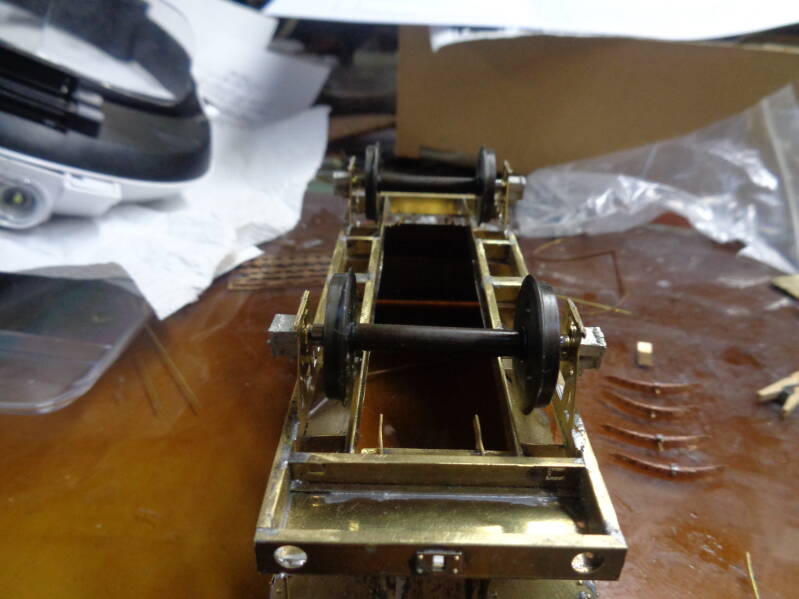
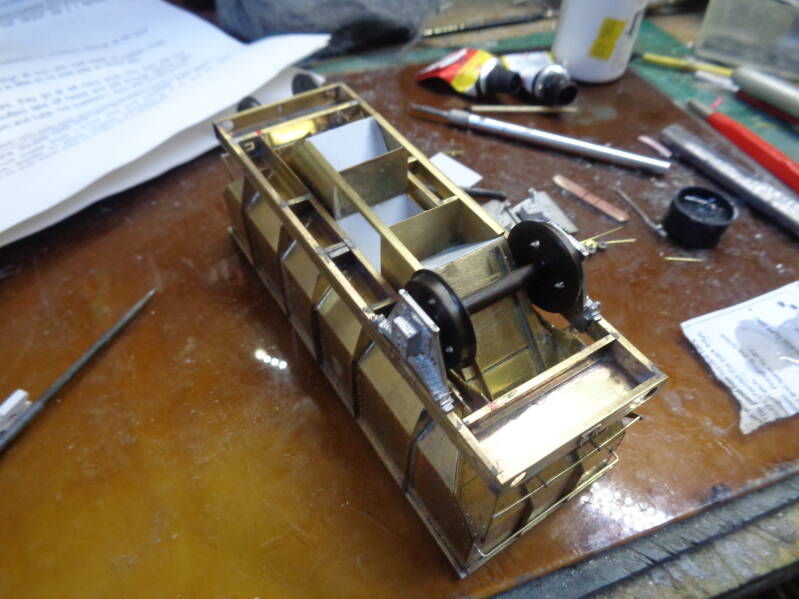
With the brake gear added, one side only which was a surprise, and instnater couplings added this wagon is done until the buffers arrive. Next I started the second of the two hoppers. Tipping all the bits out of the box I was cheerfully looking forwards to doing a welded body flavour version. Only someone had punched all (or almost all it turned out) the rivets, though not particularly heavily. Ho hum, a second rivetted jobbie it is. The body etches had not been messed with, so it all went together as intended. It says in the instructions to shorten the short cross members which I did, but when it came to placing the body into the chassis it was still too wide. So the chassis got re-built with the members shortened some more. In goes the body and the handrails etc added. Now for the wheels, using the provided axle guards this time. The holes for the bearings are oversize for the brass top hat bearings, so there's a good excuse to fit 4mm diameter roller bearings. Offering up the wheels to the chassis revealed another hitch. With the 'hole' for the body widened the wheels hit the chassis. Some hacking and cutting gets them to fit. This is a pretty terrible kit..... There's nowhere for compensation fit either.
Create Your Own Website With Webador