It's a bit difficult to take photos of electrons, so I'll just have to write stuff instead. I guess the first thing is: Did I actually need to go DCC? The answer is 'No', but with a lot of buts that will come out below. With the original layout and lots of section switches I could do anything with DC that DCC can, right?. Well, that's how I saw it, and how a lot of protagonists on the web see it, and it's not true. As an extreme example, I can have all four engines running round in a circle at the same time (you could do that in DC) and control the speed of each individually (you cannot do that in DC). But the real issue is that the 14xx's fire box glows all the time, in use or not. That's the clincher ;-)
When converting an awful lot of wire came out, and quite a lot went back in. I'd figured an 8-way solenoid driver would be the best approach to point motors, all in one place and all that (on the first version of the layout). With hindsight I'd not do that again, a solenoid decoder immediately adjacent to the points it's controlling is a much neater solution. For the saving of a few quid I spent a fortune on cable and hours of trying to remember which cable went where. Put the decoder next door and there's none of that - true two wire operation. I have two cables running round the layout visiting all the places where DCC is needed, with local decoders it would just be two short links to the decoder, one cable to the crossing vee, three short links from decoder to solenoid and that's it. Ah, but what about slo-mo DCC built in point motors you cry! Well I have three (half of my track is home brewed so latching point motors are needed) and... I don't like them. For one I like to hear a good hard snap when I switch the points, so I can hear it happened. Particularly when I'm driving from the computer and can't see the points. The display may say the points are right, but do I believe it? I've no reason not too, but well, y' know.
So, is DCC better for playing trains? Yes. Engines work better with DCC, plus you can set acceleration and braking to make it more realistic. You can mimic that to an extent like my DC controller did, but it's not the same.
Lighting? Well. it works all the time with DCC and you can control it. You can do neither with DC.
Sound? Same as lighting really. But I have to say I've given up on sound. It's a bit irritating, and with diesels at least is 'all wrong'. When moving out a siding a Class 47 with 41 tipplers on would get a bit of power applied, and then, once moving at say 5 or 10mph, would go back to idle as it trundled towards the exit. It doesn't work like a car where engine speed is related to road speed. Trains spend a lot of time coasting.
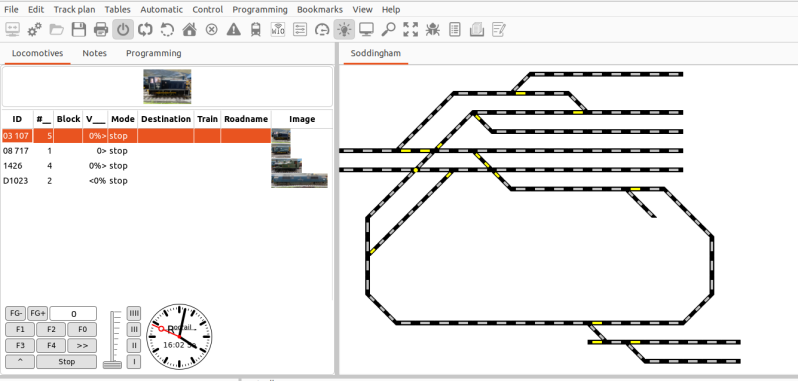
So, plugging it into a computer. I use RocRail, an open source European answer to JMRI computer software. It takes no time to set up your track plan, points use the addresses they already have (you enter the address, the software talks to the controller) and the same with engines. Driving the engines from the computer is not great, I keep letting the mouse pointer wonder off and then I have to panic when I need to slow down, but for operating the points (and doubtless other accessories) you get to play panel signalman as well as driver. UK style signalling on the computer is not really a thing without a lot of effort. So I'm ignoring it. RocRail (and the rest) can deal with bock occupancy, automatic running and doubtless tea making, but that's not my thing. RocRail can connect to phones and tablets so you can drive from there. This is ace if you need to wonder over to the other side of the layout to do a spot of shunting - no stretching of leads or running up a national debt for a radio handset for your controller.
Anyhow, that's my 2p's worth on DCC. I'm a fan, but not a fanboi.
Create Your Own Website With Webador